Financing the Family Farm: A Father's Day Look at Passing Land to the Next Generation
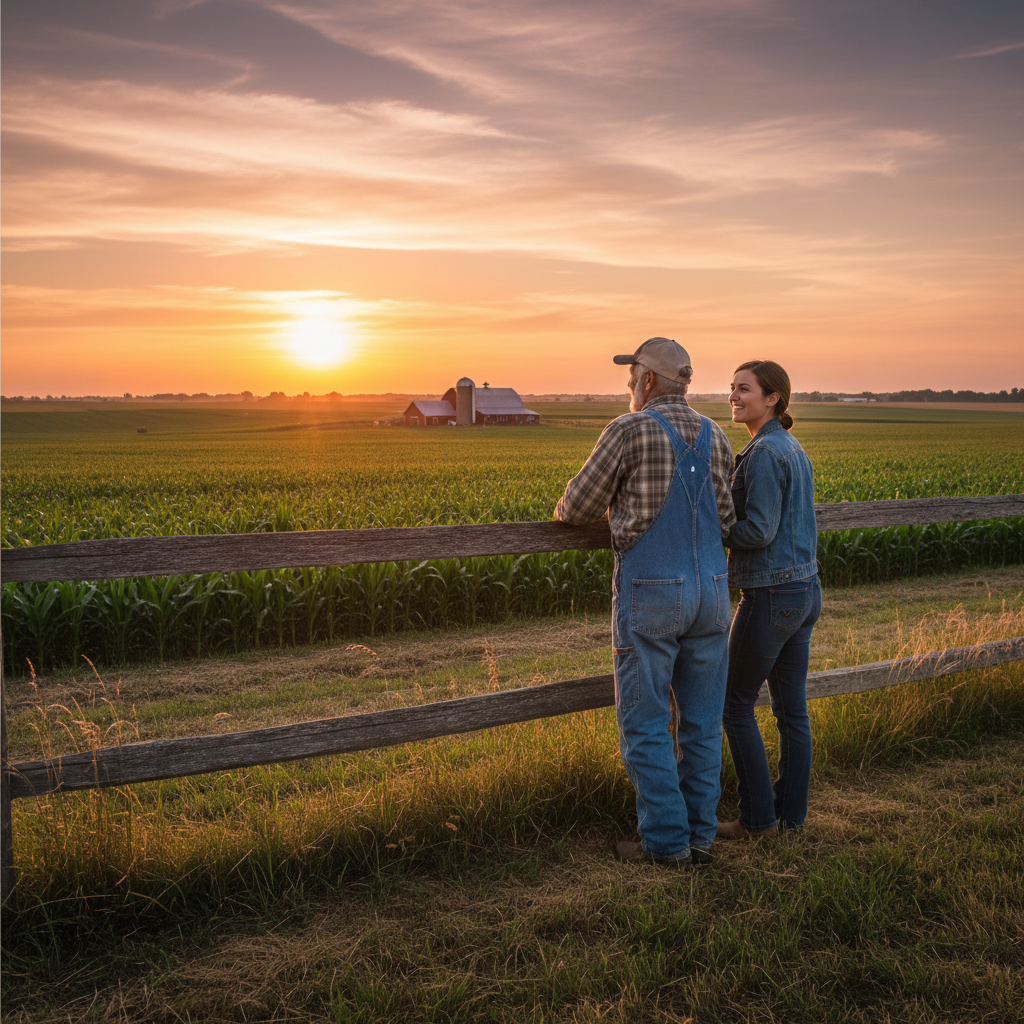
For a lot of families, the farm is more than an asset. It is the place a father taught a son to drive a tractor, the ground a mother walked at dawn, the legacy a family hopes to hand down whole. This Father's Day weekend is a fitting moment to talk about something that quietly decides whether that legacy survives the handoff: how the next generation finances the family farm.
The transition from one generation to the next is rarely as simple as signing over a deed. More often it involves real money — buying out siblings, bringing a son or daughter into ownership, or refinancing as a parent steps back. Understanding how farm financing supports that handoff is one of the most practical gifts a family can give itself.
The generational reality on America's farms
The numbers tell the story. According to the USDA's 2022 Census of Agriculture, the average age of a principal farm producer is 58.1 years, more than a third of producers are 65 or older, and fewer than one in ten is under 35. Family farms still make up roughly 95 percent of all U.S. farming operations — but a great deal of farmland is approaching a transition point.
Industry estimates suggest a large share of U.S. farmland will change hands over the next two decades, yet only a minority of farm families have a formal succession plan in place. That gap is where farms get lost — sold off, split up, or saddled with debt — not for lack of love, but for lack of planning. Financing is a central piece of that plan.
How financing supports the handoff
A generational transition usually runs into one of a few financing needs, and there is an established path for each:
- Buying out siblings or other heirs. When one child wants to keep farming and others want their share in cash, a farm real estate loan can fund the buyout so the operation stays intact and in the family.
- Bringing the next generation into ownership. A son or daughter entering the operation may need financing to purchase their stake or to acquire adjoining ground as the family scales up.
- Refinancing as a parent steps back. As the founding generation reduces its role, refinancing can restructure debt around the new operators and the farm's current cash flow.
- Seller-financed and lease-to-own arrangements. Some families bridge the handoff with a seller-financed land contract or a lease-to-own structure, often alongside a traditional loan.
The right structure depends on the family, the operation, and the goals on both sides of the table — which is exactly why it is worth planning early, with good information and good advisors.
Farm loan options worth knowing
Three broad sources finance American agriculture, and each has a role in a generational transition:
- The USDA Farm Service Agency (FSA) is the federal government's farm lender and is designed for farmers — especially beginning, small, and underserved operators — who cannot get sufficient credit elsewhere on reasonable terms. Its programs are particularly relevant to the next generation. The Beginning Farmer Down Payment Loan lets a qualifying beginning farmer contribute as little as 5 percent down, with FSA financing a portion and another lender providing the balance. FSA defines a beginning farmer as someone who has operated a farm for not more than 10 years — which describes a lot of sons and daughters stepping into ownership.
- Farm credit lenders, customer-owned cooperatives focused on agriculture, run young, beginning, and first-time farmer programs of their own.
- Commercial and community banks, particularly rural ag banks, finance farm real estate and operations and know their local markets well.
You may also hear about Farmer Mac, the Federal Agricultural Mortgage Corporation. It does not lend to farmers directly — it buys eligible loans from lenders so they can keep making new ones — but loans written to its standards can support long, fixed-rate terms that suit a multi-decade asset like farmland.
How farm loan rates are set
Rates are one of the first questions every family asks, so here is the straight version. Farm loan rates are set by each individual lender and depend on the loan type, the term, the borrower's finances, and overall market conditions. No source can promise a specific rate before a lender reviews your situation — and AgLoans does not set or quote rates.
The one place you will find published, concrete figures is the government programs. The USDA Farm Service Agency publishes its direct loan program rates on its website every month. Those are USDA program rates, not a rate a private lender or AgLoans offers, so check the current figures directly with USDA.
The wider backdrop in 2026 is a "higher-for-longer" interest-rate environment, with regional Federal Reserve surveys reporting that many agricultural lenders tightened their underwriting standards over the past year as farm margins thinned. The takeaway for a family planning a transition: a complete, well-prepared package and a clear plan matter more this year than they have in some time.
Curious what a payment might look like across different rates and terms? Run the numbers in the AgLoans farm loan calculator. It gives you an estimate to plan around — not a quote, an offer, or an approval. For figures specific to your family's situation, a lender is the only source that can give you real numbers.
Steps for a family beginning the transition
- Start the conversation early. Management transitions commonly unfold over a multi-year overlap, with the outgoing generation in an advisory role. The sooner the plan starts, the more options stay open.
- Get the operation's numbers in order. Tax returns, a current balance sheet, and cash-flow statements are the foundation of any farm loan application.
- Define the goal. Buyout, entry into ownership, refinance, or expansion — each points to a different loan type and lender.
- Compare more than one option. FSA beginning-farmer programs are built for exactly this moment, and other lenders have programs of their own.
- Bring in the right advisors. Succession touches financing, tax, and estate questions at once. A lender, an attorney, and a tax professional working together protect the farm and the family.
Where AgLoans fits
AgLoans.com is not a lender and does not make loans or credit decisions. What we do is help farm families prepare a clear, lender-ready package. We work with underwriters who work with Farmer Mac and other private funding sources, for requests of $500,000 or more with agricultural real estate to help secure the loan — so when the next generation is ready to step up, the financing piece is one less thing standing in the way.
If you would like to talk through a transition with a real person, you can reach a member of our team through the How It Works page. When you are ready to explore options, you can start an inquiry here.
To every father who built something worth passing down — and every son and daughter getting ready to carry it forward — happy Father's Day from AgLoans.
Sources
- USDA Farm Service Agency — USDA Announces June 2026 Lending Rates for Agricultural Producers (published program rates, effective June 1, 2026). https://www.fsa.usda.gov/news-events/news/06-01-2026/usda-announces-june-2026-lending-rates-agricultural-producers
- USDA National Agricultural Statistics Service — 2022 Census of Agriculture (average producer age, family-farm share). https://www.nass.usda.gov/Newsroom/2024/02-13-2024.php
- USDA Farm Service Agency — Beginning Farmers and Ranchers Loans (beginning-farmer definition, Down Payment Loan). https://www.fsa.usda.gov/resources/beginning-farmers-and-ranchers-loans
- USDA Farm Service Agency — Farm Ownership Loans (financing limits, terms). https://www.fsa.usda.gov/resources/farm-loan-programs/farm-ownership-loans
- Federal Reserve Bank of Kansas City — Agricultural Finance Updates: farm lending activity and credit conditions. https://www.kansascityfed.org/agriculture/agfinance-updates/growth-in-farm-lending-activity-persists/
AgLoans.com is not a lender, bank, or mortgage broker, and does not make loans or issue credit decisions. This article is general educational information only and is not financial, legal, or tax advice. Interest rates, loan programs, terms, eligibility, and availability are set by individual lenders, vary by borrower and operation, and change over time. Any rates referenced are published by third parties as of the date noted and should be confirmed directly with the relevant lender or agency. Calculator results are estimates for planning purposes only and are not an offer, quote, or approval. Farm succession also involves tax and estate considerations — consult a qualified lender, attorney, and tax professional about your specific situation.
Ready to take the next step?
Tell us the basics, and our team will review the next step with you. Start your free loan inquiry — estimates are fine.