
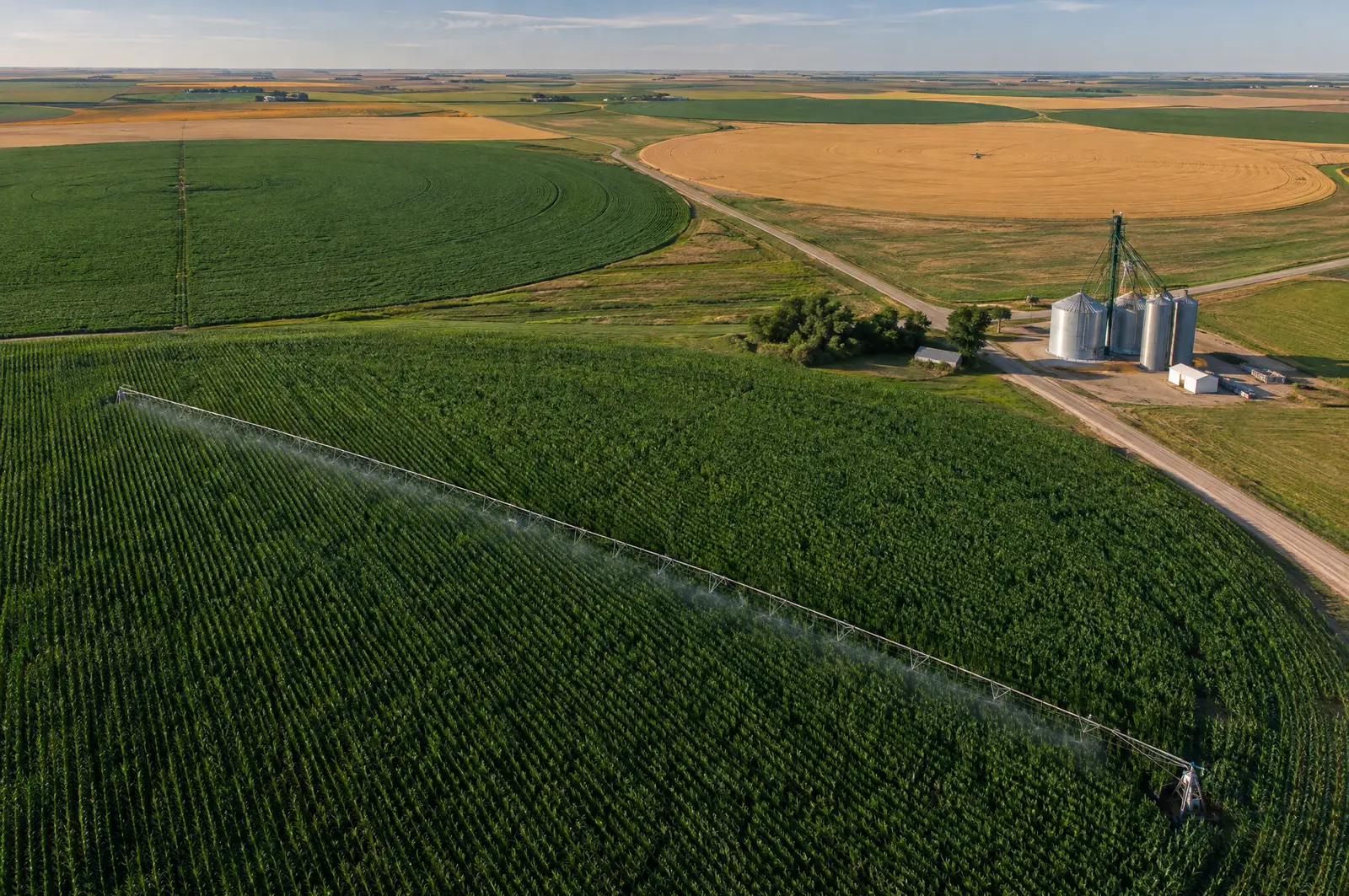
A farm real estate loan is a loan secured by agricultural land and the buildings on it. It's how most farmers and ranchers buy land, refinance, buy out family members or expand.
What Counts as Agricultural Real Estate
Cropland, pasture and ranch land, orchards and vineyards, timberland, and farm buildings such as barns, grain storage, dairy parlors and poultry houses. Recreational acreage and horse farms can qualify too, when the land secures the loan.
What Farm and Ranch Real Estate Loans Are Used For
- Buying farm or ranch land
- Refinancing an existing farm or ranch loan
- Buying out siblings or other family owners
- Building or expanding barns, storage and facilities
- Using land equity to secure an operating line of credit
How Farm Real Estate Loans Are Usually Structured
Most are long-term loans with fixed, variable or adjustable rates. Payments can be monthly, quarterly, semiannual or annual, which lets many operations match payments to when income comes in. Some programs include a balloon payment before the loan is fully paid. The lender sets the rate, term and structure; AgLoans doesn't quote them.
See understanding farmland loan terms for how these pieces fit together, or try the land loan calculator.
What Lenders Evaluate
The land and its appraisal: Soils, water, access, improvements and comparable sales.
Repayment capacity: Whether the operation and your other income can carry the payments.
Balance sheet and equity: What you own, what you owe, and how much you bring to the deal.
Credit history: How you've handled past credit.
Management experience: Your track record running the operation.
Agricultural use: How the land and buildings are used in the operation.
2026 Farmland Values: The Big Picture
USDA's USDA NASS Land Values 2026 Summary (released July 31, 2026) puts the U.S. average farm real estate value at $4,500 per acre, up $150 (3.4%) from 2025. Average cropland was $6,020 per acre (up 3.3%) and pasture $2,000 per acre (up 4.2%). Values differ widely by state:
| State | Farm real estate, 2026 | Change from 2025 |
|---|---|---|
| Alabama | $4,250 per acre | +2.4% |
| Arkansas | $4,350 per acre | +2.4% |
| California | $14,100 per acre | +2.9% |
| Colorado | $2,360 per acre | +3.1% |
| Florida | $9,150 per acre | +5.2% |
| Georgia | $4,950 per acre | +4.9% |
| Idaho | $4,750 per acre | +3.7% |
| Illinois | $9,250 per acre | +3.6% |
| Indiana | $9,150 per acre | +3.4% |
| Iowa | $10,100 per acre | +3.2% |
| Kansas | $3,200 per acre | +3.2% |
| Kentucky | $5,600 per acre | +2.2% |
| Louisiana | $3,950 per acre | +2.6% |
| Minnesota | $6,950 per acre | +2.4% |
| Mississippi | $3,650 per acre | +2% |
| Missouri | $5,200 per acre | +4% |
| Montana | $1,260 per acre | +2.4% |
| Nebraska | $4,400 per acre | +3.5% |
| North Carolina | $5,750 per acre | +5.1% |
| North Dakota | $2,450 per acre | +3.8% |
| Ohio | $9,650 per acre | +3.2% |
| Oklahoma | $2,620 per acre | +3.1% |
| South Carolina | $4,900 per acre | +3.4% |
| Tennessee | $6,500 per acre | +5.7% |
| Texas | $3,100 per acre | +4.4% |
| Virginia | $6,300 per acre | +3.3% |
| Wisconsin | $6,700 per acre | +4.4% |
Statewide averages; values for any one property vary, and the lender's appraisal sets the value used for a loan. Source: USDA NASS, Land Values 2026 Summary.
Farm and Ranch Loans vs. Residential Mortgages
Farm and ranch real estate loans are for agricultural property and are underwritten on the land and the operation. A home, including a home on acreage, is financed with a residential mortgage. AgLoans does not arrange residential mortgages.
How AgLoans Helps
We work on agricultural real estate loans from $500,000 to $25 million. We organize your information into a lender-ready package and work with underwriters who work with Farmer Mac and other private funding sources. The lender makes the credit decision.
Common Questions
What is a farm real estate loan?
A loan secured by agricultural land and the buildings on it, such as cropland, pasture, ranch land, orchards, vineyards, timber and farm facilities. It's used to buy land, refinance, buy out family members or expand.
How are farm real estate loans repaid?
Over a long amortization, with payments that can be monthly, quarterly, semiannual or annual depending on the lender and the program. Some programs include a balloon payment. The lender sets the structure.
Is a farm real estate loan the same as a residential mortgage?
No. Farm and ranch real estate loans are for agricultural property and are underwritten on the land and the operation. A home, including a home on acreage, is financed with a residential mortgage, which AgLoans does not arrange.
What is the minimum loan size AgLoans works with?
Our minimum thresholds are a loan amount of $500,000 or greater and agricultural real estate to help collateralize the loan. We review requests from $500,000 to $25 million.
Does AgLoans make the loan?
No. AgLoans.com is not a bank or lender. We organize your information and work with underwriters who work with Farmer Mac and other private funding sources. The lender makes the credit decision and sets the rate and terms.
Related: Land Loan Lenders, All Loan Programs, Preparing Your Financials.